
Keywords
orang rantai
Ombilin mines
moral leadership
colonial history
How to Cite
Abstract
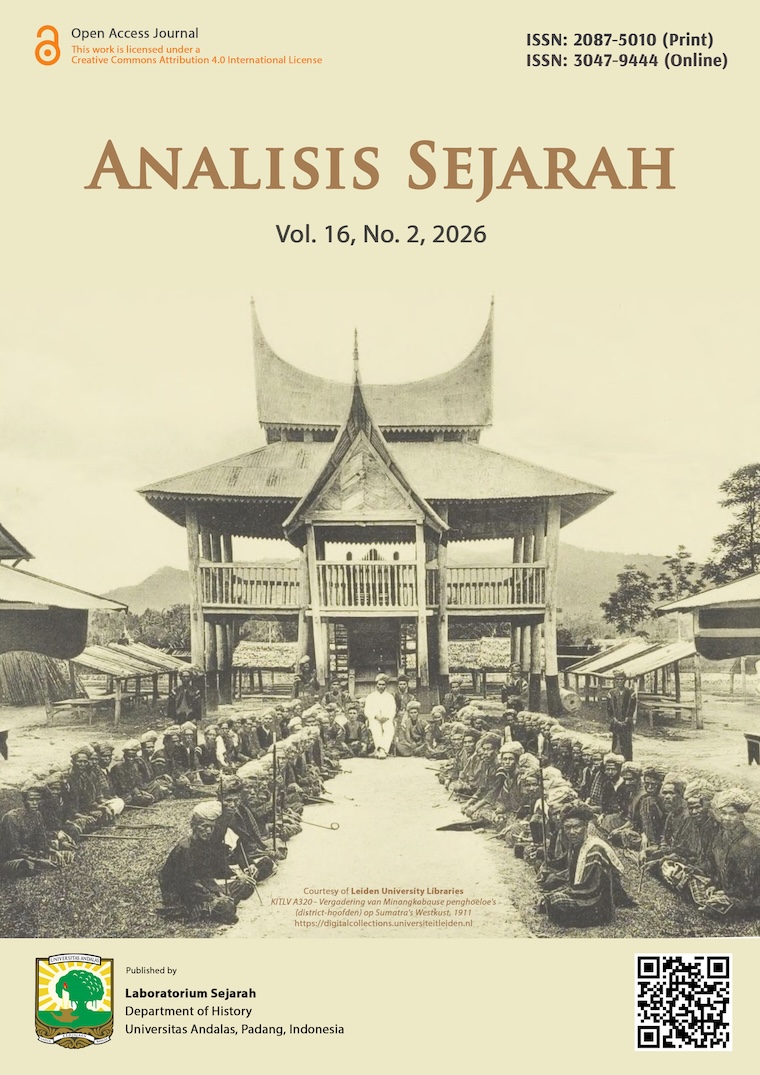
This study offers an interpretive historical rereading of the Ombilin coal mines in Sawahlunto, treating them not only as sites of colonial extraction but also as spaces in which coercive labor, criminalization, collective memory, and moral leadership intersect. It focuses on the colonial classification of orang rantai (chained laborers), questioning the assumption that this label represented a neutral legal category and considering how colonial penal practices supported coercive labor within the mining system. Using a qualitative historical approach based on document analysis of scholarly literature, institutional heritage documents, and documented public narratives, the study examines how orang rantai and the remembered figure of Mbah Soero have been represented and interpreted in historical and heritage narratives. The findings suggest that colonial penal classifications may have obscured the broader political, social, and coercive contexts in which these laborers were incorporated into the mining economy, while the remembered figure of Mbah Soero can be interpreted as embodying an ethical form of leadership grounded in solidarity and responsibility within collective memory. Rather than reconstructing the lived experiences of historical actors, this study offers an interpretive historical perspective that reconsiders colonial labor history through the interconnected dimensions of coercion, memory, and moral leadership.
References
Antara News. (2011, April 19). Menelusuri Lubang Tambang Mbah Soero. https://www.antaranews.com/berita/254836/menelusuri-lubang-tambang-mbah-soero
Antara News. (2018, February 13). Menapaki jejak kekejaman kolonial Belanda di Sawahlunto. https://www.antaranews.com/berita/685450/menapaki-jejak-kekejaman-kolonial-belanda-di-sawahlunto
Azizah, S. N., & Budiwirman, B. (2025). The historical site of Mbah Soero Coal Mine Pit Sawahlunto, West Sumatra, as a learning resource for social science education. Langgam: International Journal of Social Science Education, Art and Culture, 4(1), 13–20. https://doi.org/10.24036/langgam.v4i1.208
Bosma, U. (2019). The making of a periphery: How Island Southeast Asia became a mass exporter of labor. Columbia University Press. https://doi.org/10.7312/bosm18852
Breman, J. (1989). Taming the coolie beast: Plantation society and the colonial order in Southeast Asia. Oxford University Press.
Ediyen, A., & Tambunan, S. M. G. (2025). Orang Rantai in Sawahlunto: A state-sponsored heritage city and the politics of collective memory. In M. Budiman & A. Kusno (Eds.), Collective memory, marginality, and spatial politics in urban Indonesia (pp. 41–54). Palgrave Macmillan. https://doi.org/10.1007/978-981-97-4304-9_3
Erman, E. (1999). Miners, managers and the state: A socio-political history of the Ombilin coal-mines, West Sumatra, 1892–1996 [Doctoral dissertation, University of Amsterdam]. UvA-DARE. https://dare.uva.nl/id/c914795b-68c1-4bf0-bc78-c5dca115dad6
Erman, E. (2005). Membaranya batubara: Konflik kelas dan etnik Ombilin-Sawahlunto, Sumatera Barat, 1892–1996. Desantara.
Erman, E. (2020). Changing stages of system innovation at the Ombilin’s coal mines of Sawahlunto: From ghost town to World Heritage. STI Policy and Management Journal, 5(2), 105–119. https://doi.org/10.14203/STIPM.2020.284
Foucault, M. (1977). Discipline and punish: The birth of the prison (A. Sheridan, Trans.). Pantheon Books.
Furnivall, J. S. (1939). Netherlands India: A study of plural economy. Cambridge University Press.
International Council on Monuments and Sites. (2019). Ombilin Coal Mining Heritage of Sawahlunto (Indonesia), No. 1610: Advisory body evaluation. UNESCO World Heritage Centre. https://whc.unesco.org/document/176199
Reid, A. (2015). A history of Southeast Asia: Critical crossroads. Wiley-Blackwell.
Said, E. W. (1978). Orientalism. Pantheon Books.
Scott, J. C. (1976). The moral economy of the peasant: Rebellion and subsistence in Southeast Asia. Yale University Press.
Stoler, A. L. (1995). Race and the education of desire: Foucault’s history of sexuality and the colonial order of things. Duke University Press. https://doi.org/10.1215/9780822377719
Thompson, E. P. (1971). The moral economy of the English crowd in the eighteenth century. Past & Present, 50(1), 76–136. https://doi.org/10.1093/past/50.1.76
UNESCO World Heritage Centre. (2019). Ombilin Coal Mining Heritage of Sawahlunto. https://whc.unesco.org/en/list/1610/
van Rossum, M. (2018). The carceral colony: Colonial exploitation, coercion, and control in the Dutch East Indies, 1810s–1940s. International Review of Social History, 63(S26), 65–88. https://doi.org/10.1017/S0020859018000226
Zed, M. (2017). Warisan sejarah tambang batubara Ombilin Sawahlunto. Pemerintah Kota Sawahlunto.

This work is licensed under a Creative Commons Attribution 4.0 International License.
Copyright (c) 2026 Khairun Nadiyah, Muhammad Syarif Hidayat (Author)